
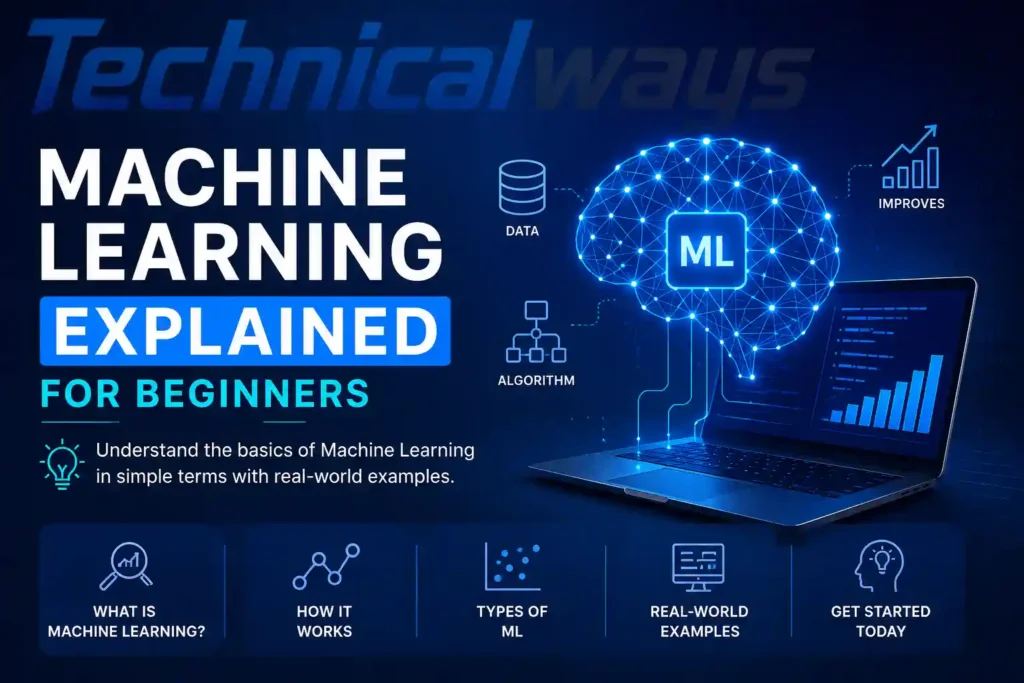
Machine learning explained for beginners often sounds more complicated than it actually is. The term gets used everywhere now, from news articles to product descriptions, but very few explanations actually break it down in a way that makes sense to someone who is not a programmer or data scientist. This guide covers what machine learning really means, how it works, and where you already encounter it in daily life without realizing it.
What Is Machine Learning
Machine learning is a branch of artificial intelligence that allows computers to learn from data and improve at a task without being explicitly programmed for every single scenario. Instead of a programmer writing out exact rules for every possible situation, a machine learning system is given large amounts of data and learns patterns from that data on its own.
Think about how a child learns to recognize a dog. Nobody sits down and explains every possible dog breed, color, and size in detail. Instead, the child sees many dogs over time and eventually learns to recognize one even if they have never seen that exact dog before. Machine learning works in a similar way, except the learning happens through data instead of experience.
How Machine Learning Actually Works
At a basic level, machine learning follows a fairly simple process, even though the technical details behind it can get complex.
First, a large amount of data is collected. This could be images, text, numbers, or any other type of information relevant to the task. Next, this data is fed into a machine learning model, which is essentially a mathematical system designed to find patterns. During training, the model makes predictions, checks how wrong or right those predictions were, and adjusts itself to improve. This process repeats thousands or even millions of times until the model becomes accurate enough to be useful.
Once trained, the model can then be used to make predictions or decisions on new data it has never seen before, based on the patterns it learned during training.
Types Of Machine Learning
Machine learning is generally divided into a few main categories, each suited for different kinds of problems.
Supervised learning involves training a model using data that already has the correct answers labeled. For example, showing a model thousands of emails labeled as spam or not spam so it learns to tell the difference on its own. Unsupervised learning works with data that has no labels at all, where the model tries to find hidden patterns or groupings by itself, often used for customer segmentation or detecting unusual activity. Reinforcement learning is a bit different, where a system learns by trial and error, receiving rewards for good decisions and penalties for bad ones, similar to how a game playing AI improves over repeated attempts.
Where You Already See Machine Learning In Daily Life
Machine learning is not some distant, futuristic concept. It is already part of everyday routines for most people, often without them noticing.
Streaming services use it to recommend movies and shows based on what you have watched before. Email providers use it to filter out spam messages automatically. Voice assistants rely on it to understand spoken language and respond accurately. Online shopping platforms use it to suggest products based on browsing and purchase history. Even the autocorrect feature on a phone keyboard is powered by machine learning working quietly in the background.
Machine Learning Vs Artificial Intelligence Vs Deep Learning
Beginners often mix up these three terms, so it helps to understand how they relate to each other.
Artificial intelligence is the broadest term, referring to any system designed to mimic human intelligence in some way. Machine learning is a subset of artificial intelligence, focused specifically on systems that learn from data. Deep learning is a further subset of machine learning that uses structures called neural networks, loosely inspired by how the human brain processes information, and is especially good at handling complex tasks like image recognition and natural language understanding.
In simple terms, all deep learning is machine learning, and all machine learning is artificial intelligence, but the reverse is not always true.
Why Machine Learning Matters
Machine learning matters because it allows computers to handle tasks that would be extremely difficult, or even impossible, to solve with traditional rule based programming. Recognizing faces in a photo, understanding natural spoken language, or predicting which customers might stop using a service are all problems that involve too many variables to code manually, but machine learning can learn these patterns directly from data.
This has opened the door to advancements across healthcare, finance, transportation, and countless other industries, where machine learning is now used to detect diseases earlier, catch fraudulent transactions, and even help develop self driving vehicles.
Common Misconceptions Beginners Should Know
A common misconception is that machine learning models understand things the way humans do. In reality, these systems recognize statistical patterns in data rather than truly understanding meaning or context the way a person would.
Another misconception is that machine learning is always accurate. In truth, a model is only as good as the data it was trained on. If that data is biased, incomplete, or poor quality, the model’s predictions will reflect those same flaws, sometimes in ways that are not obvious right away.
Getting Started With Machine Learning As A Beginner
For someone curious about learning more, starting with the basics of how data works and what patterns actually mean in a dataset is more useful than diving straight into complicated algorithms. Free beginner friendly courses and simple hands on projects, like building a basic model that predicts something using a small dataset, help make the concept feel much less abstract.
Understanding the logic behind machine learning is far more valuable at the beginning than memorizing technical formulas, especially for someone just starting to explore the field.
Frequently Asked Questions
Is machine learning the same as artificial intelligence?
No. Machine learning is a subset of artificial intelligence, focused specifically on systems that learn from data rather than being explicitly programmed for every task.
Do I need to know programming to understand machine learning?
Not to understand the basic concept, but building or working with machine learning models does typically require programming knowledge, often in languages like Python.
Can machine learning models be wrong?
Yes. Machine learning models can make incorrect predictions, especially if the data used to train them was limited, biased, or of poor quality.
What is the easiest way to start learning about machine learning?
Starting with beginner friendly online courses and simple hands on projects is usually more effective than trying to learn complex theory first.
Is deep learning better than regular machine learning?
Not necessarily better, just different. Deep learning tends to perform well on complex tasks like image and speech recognition, but traditional machine learning methods are often simpler and more efficient for smaller or less complex problems.
Also read about: Which Gadget Is Best For Daily Use